
Employee engagement is a top priority for HR teams. Engaged workers are more productive, more loyal, and more likely to stay. But reaching every employee — especially when your workforce is distributed, deskless, or remote — is a real challenge. Traditional email alone often doesn’t cut it.
That’s where leveraging both SMS and email together can transform your internal communications. HR leaders can implement a multichannel strategy to reach employees faster, make messages more personal, and encourage real back-and-forth conversations. When used right, this approach can dramatically boost engagement.
Why HR Communication Needs to Evolve
HR communication has often been stuck in a slow, one-sided model. You send out mass email blasts for policy updates, benefits enrollment, or company news but many employees don’t read or respond.
Today’s workers expect faster, more mobile, more personal communication. They’re used to texting and instant messaging in their daily lives. If HR sticks to email only, it risks being ignored or lost in a crowded inbox.
Plus, many employees don’t have a desk job. They might be hourly workers, remote, or on the move. They may not check their email regularly, or they may feel disconnected from what HR is saying. To truly engage them, HR needs a fresh, mobile-first communication tool, one that meets people where they are and lets HR deliver messages that matter, in real time.
The Shift Toward Faster, Mobile-First Employee Communication
Mobile devices are now the primary way many people communicate. Text messaging is ubiquitous. In a work context, SMS can reach employees instantly, wherever they are.
HR teams are catching up. They are realizing that mobile-first communication is not just an add-on—it’s a necessity. Using SMS, HR can send reminders, alerts, benefit updates, and more directly to the phones of their workforce.
But SMS on its own has limits, especially for long-form content or detailed explanations. That’s why the most effective approach is to combine SMS with email. When HR uses both channels, it gains flexibility: short, urgent nudges via text and longer, resource-rich content via email.
Introducing Flimp Connect and How It Works
Overview of the Flimp Connect Platform
Flimp Connect is a communication tool built for HR teams. It helps HR send out messages via SMS, MMS, email, and two-way messaging. Because it’s designed for ease of use, HR doesn’t need to rely on IT to set things up or maintain the system.
The goal is simple: help HR teams communicate better, faster, and more personally.
Multichannel Capabilities: SMS, MMS, Email, and Two-Way Messaging
One of the biggest strengths of Flimp Connect is its multichannel capability. You can send:
- SMS (text-only messages for quick alerts)
- MMS (multimedia texts for richer content)
- Email (for longer, detailed messages)
- Two-way messaging (so employees can reply, ask questions, or engage in a conversation)
This mix ensures you can tailor your outreach based on message type, urgency, and audience.
No-IT-Required Setup for HR Teams
Flimp Connect is built to be HR friendly. You don’t need technical expertise or heavy IT involvement to get started. This means HR teams can run campaigns, broadcast messages, or set up automated workflows on their own.
This reduces bottlenecks and ensures HR communication remains agile.
Built-in Analytics for Tracking Employee Response and Engagement
Data is critical. With Flimp Connect, HR gets built-in analytics: open rates, response rates, delivery logs, and more. These metrics help HR teams see which messages are effective, who is not engaging, and where they need to improve.
This insight allows for continuous refinement of communication strategy, ultimately increasing engagement over time.
Why SMS Is a High-Impact Channel for HR
SMS Open Rates vs. Email
One of the biggest reasons SMS is powerful for HR is its open rate. Text messages are opened far more consistently than email. Because SMS is immediate and personal, employees are more likely to read it quickly.
When HR wants to be sure a message is seen especially time-sensitive ones SMS is a top choice.
Real-Time Read and Response Patterns
SMS enables real-time engagement. Employees often check texts as soon as they receive them, and many reply promptly. This immediacy is valuable for HR when sending out reminders, checking pulse, or seeking quick feedback.
That real-time read and response pattern makes SMS a direct line to employees’ attention.
Reaching Deskless, Hourly, and Distributed Employees
Not every employee works in an office. Many are deskless in retail, manufacturing, remote, or field-based roles. These workers may not use email regularly, but they almost always carry a phone.
With SMS, HR can reach these employees easily, bypassing the limitations of desktop systems.
Encouraging Two-Way Conversations Between HR and Employees
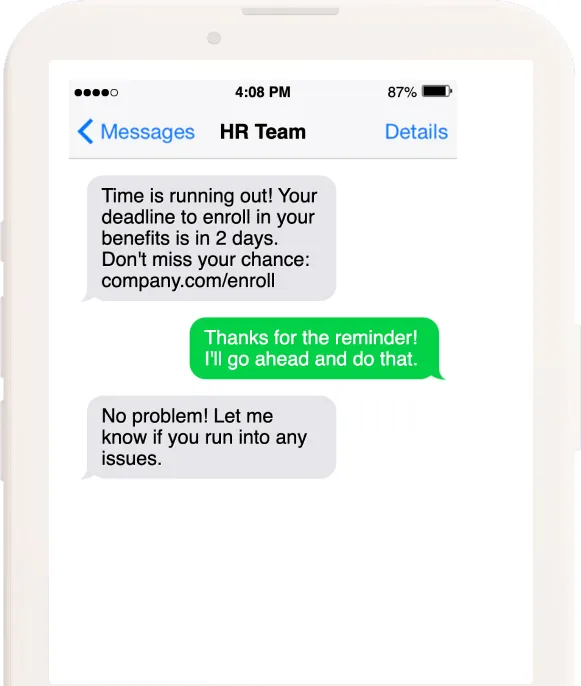
SMS isn’t just for broadcasting. With Flimp Connect, HR can enable two-way messaging. That means employees can text back. They can ask questions, share concerns, or reply to check-ins.
This kind of conversational channel builds trust. It helps HR feel more accessible and lets employees feel heard. Over time, that builds engagement.
The Role of Email in HR Communication
Using Email for Long-Form and Resource-Heavy Content
Email shines when you need to share attachments, share PDFs, or embed links to policies or long guides.
For example, during benefits enrollment, HR can send an SMS alert to remind employees to check their email. Then, the detailed benefit-plan guide goes via email, where employees have space to digest the information and click through relevant links.
Segmenting Employee Email Lists for Higher Engagement
Not all employees are the same. Some are hourly, some remote, some in management. HR should segment email lists, so messages are relevant.
Segmenting helps HR send exactly the right content to the right people. For example, emails about leadership training shouldn’t go to all staff only managers. Or information about shift scheduling may only go to hourly workers.
By targeting, open rates go up, and employees feel the communication is meaningful.
Future of HR Communication
Rise of Mobile-First Internal Communication
We’re already seeing a trend: more HR teams are prioritizing mobile-first communication. Text messaging is no longer a “nice-to-have,” it’s central.
As workforce demographics shift (more deskless, more remote), mobile-first tools will become essential in HR communications.
Growth of AI-Powered HR Assistants
AI is transforming HR. In future, AI-powered assistants could help HR send personalized messages, answer employee queries via SMS or email, and even analyze sentiment.
Imagine an AI that nudges an employee to enroll in benefits and then answers their follow-up questions via text instantly.
Integrating SMS and Email with HRIS and Benefits Platforms
To get the most value, HR should integrate Flimp Connect with existing systems like HRIS, payroll, and benefits platforms. When integrated:
- You can trigger texts or emails based on data (e.g., new hire, open enrollment)
- Your messages become more relevant and timelier.
- You reduce manual effort and ensure communications are aligned with other HR processes
And, if you integrate Flimp tools with your benefits system, you can draw on a decision-support tool to guide employees.
Employee engagement is critical, and HR’s ability to communicate effectively makes a big difference. By combining SMS and email, HR teams can reach more people, encourage more interaction, and deliver messages in the right format.
Flimp Connect provides a purpose-built platform for HR: SMS, MMS, email, two-way messaging, analytics all without needing heavy IT. It helps teams send real-time nudges, long-form resources, and compelling updates in a way that resonates.
As HR communication evolves, mobile-first strategies will become the norm. AI and automation will make messaging smarter. And with solutions from Flimp, HR leaders can confidently build a communication framework that meets the needs of every employee whether they work at a desk, on the shop floor, or remotely.
FAQs
1. How can HR use SMS for employee engagement?
HR can send quick reminders, alerts, and updates using SMS. This reaches employees fast and helps HR connect in real time. It works well for urgent or short messages.
2. Why should HR teams combine SMS with email?
SMS reaches people fast. Email shares longer detail. When used together, they help HR improve delivery, clarity, and engagement. Employees get the right message in the right format.
3. What type of HR messages work best over SMS?
Short alerts, deadlines, reminders, and quick check-ins work well over SMS. Messages that need fast attention or a simple reply are ideal for texting.
4. When is email better than SMS for HR communication?
Email works best for long guides, benefits documents, onboarding steps, and policy updates. These need space and links, so email is more effective.
5. How does an employee-texting platform help HR?
It lets HR start two-way conversations with staff. Employees can reply with questions or feedback. This builds trust and boosts engagement.